

$800,000 · most popular
Through a regional center
An investment in a TEA (Targeted Employment Area). A passive investment managed by professionals. Both direct and indirect jobs count. Funds are returned in 5-7 years under the project terms.
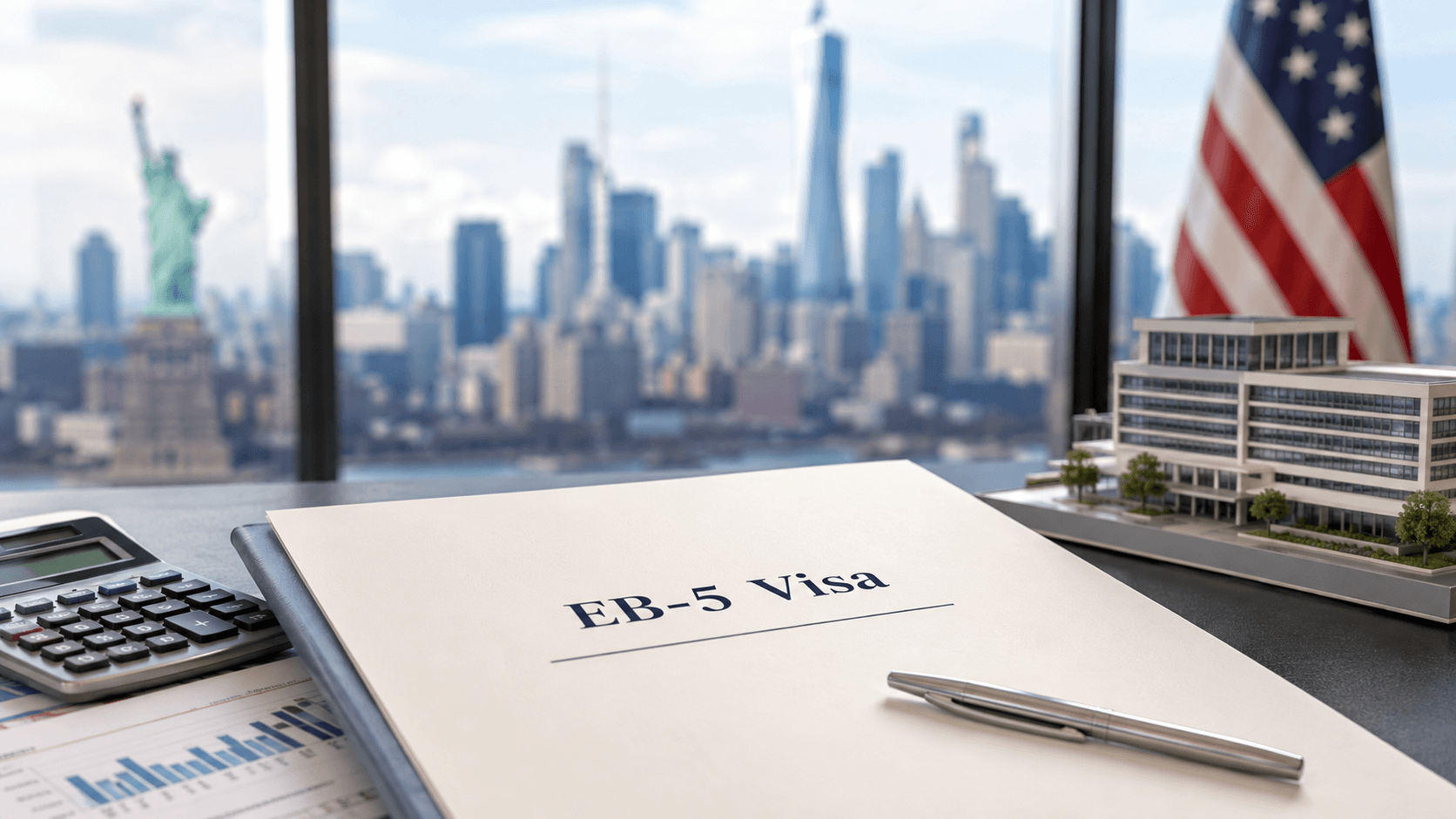
An immigrant visa for those ready to invest $800,000 or more in the US economy. A Green Card for you, your spouse, and your children under 21 — no employer, no proof of extraordinary talent, no per-country quotas.
You, your spouse, and your children under 21 receive status at the same time. The whole family becomes US permanent residents.
No need to find a US petitioner. No need to prove outstanding achievements or hold a college degree.
$800,000 through a regional center in a TEA, or $1,050,000 when investing directly in your own business.
Your I-526E visa petition gets approved or you get your money back. The terms are written into the contract.
EB-5 is the only US immigration path that requires no proof of professional achievements, no job offer from an employer, and no specific education. You invest $800,000 or more in a USCIS-approved project, create 10 jobs — and receive a Green Card for the whole family. The investment is not a purchase of status: your funds are returned once the program requirements are met (typically after 5-7 years).
An investment in a TEA (Targeted Employment Area). A passive investment managed by professionals. Both direct and indirect jobs count. Funds are returned in 5-7 years under the project terms.

An investment in your own or a partner business. Active management — you are operationally involved. Only direct jobs count, and you need at least 10. A good fit if you already have a business idea and a team.

Several investors fund a single project. Jobs are allocated proportionally. Often arranged through investment clubs and funds. A good fit if you want to lower your risk through diversification.
Do you have a university degree and significant professional achievements? Find out which visa type is right for you.

Senior developers, architects, Data Science and AI specialists — with patents, conference talks, or high-load projects.

PhDs and researchers with publications, grants, and citations in peer-reviewed journals.
Tech entrepreneurs, business owners, and startup founders ready to launch or scale a company in the US market.
Leaders of international companies — a transfer to a US office or a Green Card through EB-1C.
From $800K in EB-5 or $100K in E-2 — a Green Card and status for your whole family.

Painters, musicians, film directors, and designers with exhibitions, festivals, and awards.

Surgeons, physicians, and clinical researchers with publications and professional recognition.

Professors, lecturers, and experts with academic work and international recognition.

Athletes and coaches with podium finishes, rankings, and national team experience.

Influencers, journalists, and media personalities with an audience, reach, and publications.
Don't see your profession here? We work with professionals from many different fields.
Check if I qualify$800,000 when investing in a TEA (Targeted Employment Area — an area with high unemployment or a rural area). $1,050,000 for direct investment in any other region.
A complete documented chain showing where your capital came from: tax returns, bank statements, sale, gift, and inheritance agreements. Gaps in the SoF are the most common reason for denials.
The investment must create at least 10 full-time jobs for US citizens / residents. Through a regional center, both direct and indirect jobs count; with direct investment — direct jobs only.
The project must be located in a TEA — Targeted Employment Area: an area with unemployment above 150% of the national average, or a rural area with a population under 20,000. Confirmed by a letter from the state.
The funds must be transferred and exposed to market risk. Guaranteed returns, buy-backs, and deposits do not qualify. The money works in a real business — hotels, construction, manufacturing.
The regional center must be registered with USCIS and pass vetting under the EB-5 Reform and Integrity Act of 2022. Your attorney reviews the center’s track record, financial model, and SEC filings before you invest.
Neither the applicant nor their family members may have US visa violations, deportations, or denials flagged for misrepresentation. Criminal history is checked separately — some offenses are disqualifying.
An attorney will review your case — assess your source of funds, recommend an investment format (regional center / direct / pooled), and compare EB-5 with the alternatives (E-2, L-1). Free of charge.
You fill out a questionnaire, and our specialists analyze your case in detail to assess your real chances of approval. At this stage you already see which path is the most promising for you. We then contact you to schedule an online meeting that suits you.
Take the first step — get a free expert consultation and an eligibility checklist
Consultation| Stage | Timeframe |
|---|---|
| Case and Source of Funds assessment | 1-3 weeks |
| Project selection and investment | 2-6 weeks |
| Preparing the I-526E petition | 1-3 months |
| USCIS processing | 12-18 months |
| Conditional Green Card (consulate / AOS) | 2-6 months |
| Removing conditions (I-829) | after 2 years |
The longest stage is USCIS processing of the I-526E. The speed depends on the agency’s workload and the applicant’s country. Since 2022, TEA cases get priority — rural projects are reviewed faster.
At Migrator, every case passes 3 stages of document review — a coordinator, an attorney, and a senior partner. Your case goes to USCIS only when it is fully ready. The final word — and the filing itself — belongs to a licensed US attorney.
Every EB-5 case is handled by a licensed US attorney specializing in investment immigration. The company takes the financial risk on itself — it is written into the contract.
* The 95% approval rate is an approximate figure based on approved cases across different time periods and visa categories.

Every case is handled by a licensed US attorney specializing in EB-5. They know how USCIS evaluates Source of Funds and which projects pass vetting.

I-526E approval or a full refund of the legal fee — the terms are written into the contract. Migrator takes the financial risk on itself — this is not a marketing gimmick.

The price is set before the contract is signed. RFE responses, additional consultations, case adjustments — everything is included. Government fees are not included.

In your personal chat: the department head, a supervisor, a paralegal, a case manager, and an AI bot. Weekly updates on your case status.

A coordinator checks completeness, an attorney checks the legal strength of your Source of Funds, and a senior partner reviews the case strategy. The petition passes three filters before it is filed with USCIS.

We help you choose a state and a bank, sort out taxes, and settle your family in. We stay with you through removal of conditions (I-829) and beyond — all the way to naturalization if needed.

Since 2022, the minimum TEA investment has been $800,000 (up from $500,000). USCIS is discussing the next adjustment: experts expect the TEA minimum to rise to $1,000,000 in the coming years.
Standard I-526E processing has grown from 18 to 24+ months. The sooner you file, the sooner you get your Green Card. The cut-off date for some countries has already moved backward.
The annual EB-5 limit is 10,000 visas with per-country quotas. Applicants from China and India already face longer waits. Application volume grows every year.
Children who are already 18-20 risk running out of time. If a child turns 21 before approval, they drop out of the application. The CSPA (Child Status Protection Act) does not always protect them.
Fill out the form — an immigration specialist will contact you with a free assessment of your case.
Not sure you’d qualify? See real client cases — with USCIS approval letters.
View case studiesForm I-526E is filed at the beginning of the EB-5 process by an investor participating in a regional-center project. It documents the lawful source of funds, the investment’s compliance with program requirements, and eligibility for immigrant status. After approval, the investor may complete consular processing or file for Adjustment of Status in the United States and receive a conditional Green Card. Form I-829 is filed later to remove the conditions from permanent resident status. It must be filed during the 90-day period before the second anniversary of conditional residence. At that stage, the investor documents that the investment was sustained for the required period and that program requirements, including job creation, were met. After approval, the investor and qualifying family members receive permanent Green Cards without conditions. In short, I-526E opens the route to conditional residence, while I-829 removes the conditions and confirms permanent resident status.
Form I-526E by itself does not authorize a person to live, work, or enter the United States. In some cases, a person who is already lawfully present and has an immediately available immigrant visa may be eligible to file separate related applications.
Yes. The queue is generally based on country of birth, known as the country of chargeability, rather than citizenship. The Department of State publishes current availability each month in the Visa Bulletin. As of July 2026, EB-5 remains Current (C) for applicants born in Russia, Ukraine, Kazakhstan, Belarus, Armenia, Georgia, and Israel. That means there is no visa-number backlog for those countries, and a qualifying case may proceed without waiting for immigrant-visa availability. Current EB-5 limits primarily affect countries with exceptionally high demand, especially India and China in certain investment categories. For investors born in Russia, Ukraine, Kazakhstan, Belarus, Armenia, Georgia, and Israel, the absence of a backlog makes the process more predictable. The timeline depends mainly on USCIS petition review and later immigrant-visa processing rather than waiting for a priority date to become current.
Conditional residence begins on the date the person becomes a U.S. permanent resident. This is either the date of admission to the United States with an immigrant visa or the date USCIS approves Adjustment of Status inside the United States. The two-year conditional period starts on that date. Near the end of the two-year period, the investor must file Form I-829 to remove the conditions. The filing window is the 90-day period before the second anniversary of conditional residence. After I-829 approval, the investor and qualifying family members receive permanent Green Cards without conditions.
A return may be possible, but USCIS does not guarantee repayment. EB-5 requires the capital to remain “at risk” for gain or loss, which means the investor cannot receive an advance guarantee that the money will be returned. If a project fails, recovery depends on its financial condition, the transaction structure, and the investment documents. Some investors may recover part or all of their capital, while others may sustain a loss. Project selection should therefore include a review of the regional center’s experience, financial model, loan security, capital-repayment history, and legal structure. Strong projects may describe a repayment mechanism after the EB-5 requirements are met, but no project may guarantee a return of capital before the investor is eligible to remove the Green Card conditions.
The evidence usually traces both the source and movement of the money, such as employment or business income, asset sales, dividends, inheritance, loans, and bank transfers. The exact document set depends on the source.
The principal applicant can generally include a spouse and unmarried children under age 21 as derivative beneficiaries.
The consequences depend on the stage of the case and the USCIS rules in effect. The impact should be evaluated using the official notices and the documents for the specific project.